
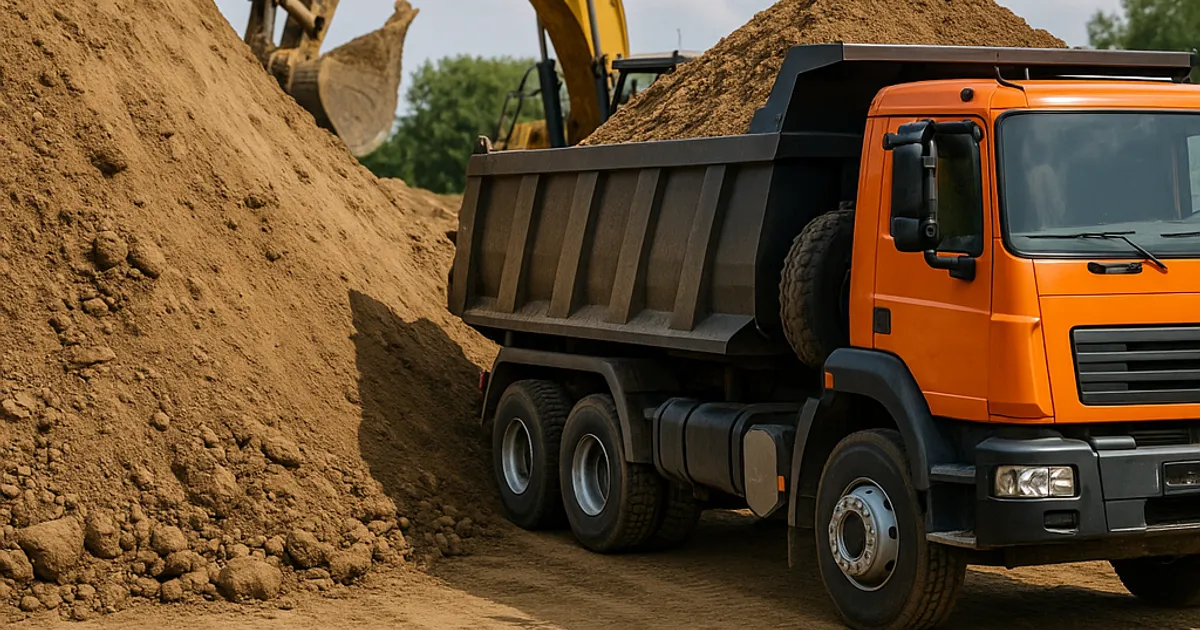
For contractors, developers, and project managers, dirt disposal is rarely glamorous — but it's almost always expensive. What looks like a simple line item on a budget sheet can balloon into one of the largest cost centers on a construction project. Industry data from the National Excavation and Earthmoving Association consistently shows that earthwork cost overruns are among the leading causes of construction project budget failures, with soil disposal accounting for a disproportionate share of those overruns.
The national average cost to haul and dispose of clean fill dirt ranges from $150 to $400 per truckload, but when complications arise — contamination, regulatory changes, market shifts, or poor planning — that figure can easily climb to $800, $1,500, or even higher per load. On large commercial projects moving tens of thousands of cubic yards of material, a cost increase of even $5 per cubic yard can translate to hundreds of thousands of dollars in unexpected expense.
Understanding why dirt disposal costs rise isn't just academic. It's a practical skill that separates contractors who consistently deliver profitable projects from those who constantly fight budget fires. This guide digs deep into every major cost driver, from soil contamination and regulatory compliance to fuel surcharges and the hidden inefficiencies of poor material matching.
1. Soil Contamination and Environmental Testing Requirements
Contamination is the single biggest wildcard in dirt disposal budgets, and it can transform an inexpensive fill-dirt haul into a hazardous waste disposal event costing ten times as much — or more.
What Counts as Contaminated Soil?
Under EPA guidelines for solid waste and remediation, soil becomes regulated waste when it contains concentrations of hazardous substances above defined thresholds. Common contaminants encountered on excavation sites include:
- Petroleum hydrocarbons (TPH): Often found on former gas station sites, industrial properties, and older commercial lots
- Heavy metals: Lead, arsenic, chromium, and cadmium are frequently detected in urban soils with industrial histories
- Chlorinated solvents: PCE and TCE from dry cleaning operations, manufacturing, and military facilities
- Polychlorinated biphenyls (PCBs): Common in soils near electrical infrastructure and older industrial sites
- Per- and polyfluoroalkyl substances (PFAS): An increasingly regulated emerging contaminant found near airports, military installations, and firefighting training areas
The Cost Cascade of Contamination Discovery
When contamination is discovered mid-project, costs don't just increase — they cascade. A project that budgeted $200 per truckload for clean fill disposal suddenly faces:
- Environmental testing: Phase I ESAs cost $1,500–$6,000; Phase II assessments with soil borings run $5,000–$30,000+
- Regulatory notifications: Many states require notification to environmental agencies within 24–72 hours of discovery, triggering oversight requirements
- Manifesting and tracking: Hazardous waste must be transported under a federally regulated manifest system per 40 CFR Part 262
- Licensed disposal facilities: Class I hazardous waste landfills charge $300–$900 per ton, compared to $10–$40 per ton for clean fill at a standard facility
- Project delays: Permitting and remediation planning can pause earthwork for weeks or months
Prevention Strategies
Pre-construction soil sampling is the most effective way to avoid contamination surprises. ASTM Standard E1527-21 governs Phase I Environmental Site Assessments, while ASTM E1903-19 covers Phase II investigations. Investing $5,000–$15,000 in pre-construction environmental due diligence is almost always cheaper than discovering contamination after excavation has begun.
2. Increasing Haul Distance and Fuel Costs
Even with perfectly clean soil, the economics of dirt disposal are heavily driven by distance. Fuel represents 35–45% of the operating cost of a typical dump truck, according to the American Trucking Associations, making haul distance one of the most controllable — and most commonly mismanaged — cost variables in earthwork.
The True Cost of Every Extra Mile
A standard tri-axle dump truck hauling 14–16 cubic yards of material gets approximately 5–7 miles per gallon when loaded. At $4.00/gallon diesel prices (a common recent benchmark), every additional mile of one-way haul distance adds roughly $0.60–$0.80 in direct fuel cost per load. Add in driver time at $35–$55/hour, tire wear, and equipment depreciation, and the all-in cost per additional mile approaches $2.50–$4.00 per load.
For a project moving 5,000 cubic yards of material (approximately 350 truckloads), the difference between a 5-mile haul and a 25-mile haul can easily exceed $140,000 in total disposal cost — before accounting for any other factors.
Diesel Price Volatility
Diesel prices have shown dramatic volatility over the past decade. The U.S. Energy Information Administration's (EIA) data shows diesel prices ranging from a low of $2.30/gallon in 2020 to peaks above $5.70/gallon in mid-2022. Most earthwork bids lock in rates at a specific fuel price, and when diesel costs surge unexpectedly mid-project, contractors either absorb the loss or must renegotiate — often a painful conversation.
How Smart Material Matching Reduces Haul Distance
The most effective antidote to excessive haul distances is finding a project nearby that actually needs the material you're trying to dispose of. A development site 3 miles away that needs 4,000 cubic yards of structural fill is infinitely more valuable than a landfill 30 miles away that charges tipping fees on top of the haul cost.
This is exactly the problem that DirtMatch was built to solve. By connecting excavation contractors with nearby projects that need fill material, the platform enables both sides to dramatically reduce their per-yard disposal and acquisition costs. Instead of paying to haul dirt to a distant landfill, contractors can often transfer material to a receiving site much closer — sometimes within the same zip code.
3. Tipping Fees and Landfill Rate Increases
Even when you're disposing of clean, uncontaminated fill dirt, landfill tipping fees have been rising consistently across the United States. Data from the Environmental Research & Education Foundation (EREF) shows that average municipal solid waste landfill tipping fees increased by more than 34% between 2015 and 2022, and construction and demolition debris landfills — where clean fill is often disposed — have seen similar trajectories.
Regional Variation in Tipping Fees
Tipping fee variation by region is dramatic:
| Region | Avg. Tipping Fee (Clean Fill) | Avg. Tipping Fee (C&D Debris) |
|---|---|---|
| Pacific Coast (CA, WA, OR) | $45–$95/ton | $75–$140/ton |
| Northeast (NY, MA, CT) | $55–$110/ton | $80–$160/ton |
| Mountain West (CO, UT, NV) | $25–$55/ton | $45–$90/ton |
| Southeast (GA, FL, SC) | $18–$40/ton | $30–$65/ton |
| Midwest (OH, IL, MN) | $20–$45/ton | $35–$75/ton |
| Texas/Gulf Coast | $15–$35/ton | $28–$58/ton |
In high-cost markets like the San Francisco Bay Area and greater Boston, tipping fees have reached levels that make even small-project soil disposal a significant budget line. Contractors working in these markets have a powerful financial incentive to find alternative placement sites for their excavated material.
Why Fees Keep Rising
Several structural forces are pushing tipping fees higher over time:
- Landfill capacity constraints: The number of operating landfills in the U.S. has declined from over 8,000 in 1988 to approximately 1,900 today, per EPA data. Fewer facilities serving growing volumes means pricing power for operators.
- Environmental compliance costs: More stringent liner requirements, leachate management systems, and post-closure care obligations under RCRA Subtitle D increase operating costs that are passed to users
- Opposition to new facilities: NIMBY dynamics make permitting new landfills extremely difficult in densely populated regions
- Transportation infrastructure costs: Many facilities pass along fuel surcharges and infrastructure levies that increase over time
4. Regulatory Compliance and Permitting Complexity
The regulatory landscape governing soil disposal has grown substantially more complex over the past two decades, and non-compliance carries consequences that dwarf the cost of compliance itself.
Federal Regulatory Framework
At the federal level, soil disposal is governed primarily by the Resource Conservation and Recovery Act (RCRA), the Clean Water Act (CWA), and — for sites with contamination above certain thresholds — CERCLA (Superfund). Key compliance requirements include:
- Solid waste characterization: Determining whether excavated soil qualifies as solid waste, non-hazardous solid waste, or hazardous waste under 40 CFR Part 261
- Waters of the U.S. (WOTUS) regulations: Disposal near wetlands, streams, or other regulated waters requires Section 404 permits from the Army Corps of Engineers
- Air emissions: Large-scale earthmoving operations in nonattainment areas may trigger fugitive dust requirements under state implementation plans
State-Level Variation Creates Complexity
Beyond federal baseline requirements, each state maintains its own soil disposal regulatory framework, and these vary significantly. California's DTSC (Department of Toxic Substances Control) maintains some of the nation's most stringent soil characterization thresholds. Massachusetts DEP's soil management regulations under 310 CMR 40.000 impose specific tracking requirements for any soil moved from a Tier I classified site. Washington State's Model Toxics Control Act (MTCA) sets cleanup standards that affect whether soil can be reused or must be disposed.
For contractors operating across state lines — or even across county lines — tracking these requirements adds administrative cost and compliance risk.
Permit Delays and Their Cost
When permits are required and processing timelines are long, the carrying costs of delay can rival the permit fees themselves. Equipment sitting idle on a job site costs $500–$2,500 per day depending on the machine. Crews on standby incur labor costs. Financing costs on project capital continue accruing. These delay costs are rarely included in initial disposal cost estimates, but they represent a very real component of total disposal expense.
5. Soil Classification and Material Type Surprises
Not all dirt is created equal, and the physical characteristics of excavated material have a major impact on disposal cost.
Rock vs. Soil: A Significant Cost Difference
Excavating rock costs significantly more than excavating soft soil — typically 3–8x more per cubic yard when blasting or specialized equipment is required. But the disposal side can also present surprises. Some fill sites accept only specific material gradations. Recycling facilities that take concrete and aggregate may not accept mixed soil and rock. Landfills may charge higher rates for heavy, dense materials that impact cell airspace differently.
Expansive Clays and Problem Soils
Highly plastic clays, organic soils, and materials with high moisture content can be rejected by fill sites that need structurally sound material for compaction purposes. A contractor expecting to place 2,000 cubic yards of clay from a basement excavation at a nearby development site may discover that the receiving project's geotechnical specifications prohibit high-plasticity soils per ASTM D2487 (Unified Soil Classification System) standards. This sends material back to the landfill queue — with all associated costs.
Unexpected Rock Encounters
Geotechnical reports don't always capture every subsurface condition. When boring spacing is too wide, hard rock layers can be missed entirely. Encountering rock when the budget assumed soft soil excavation triggers equipment mobilization costs for breakers or blasting crews — and may require separate disposal arrangements for oversized material.
6. Poor Planning and Inefficient Material Management
A surprising proportion of elevated dirt disposal costs stem not from external factors but from internal planning failures. The most expensive dirt to dispose of is often dirt that could have been used on the same project — or placed at a nearby site for free — with better upfront planning.
The Cut-Fill Balance Problem
Every grading project has a cut-fill balance: the difference between the volume of material excavated (cut) and the volume needed to build up low areas (fill). When this balance is calculated incorrectly, projects generate surplus material that must be removed — or incur deficits requiring imported fill at additional cost. Industry studies suggest that cut-fill miscalculations affect a majority of projects to some degree, with significant errors occurring frequently enough to represent a systemic problem.
Shrink and Swell Factors
Soil volume changes when it moves from its natural state. Bank material (in-ground) expands when excavated (loose factor) and compresses when compacted as fill (swell factor). These conversion factors, which vary by soil type, are frequently miscalculated:
| Soil Type | Bank-to-Loose Factor | Bank-to-Compacted Factor |
|---|---|---|
| Sandy loam | 1.15–1.18 | 0.85–0.90 |
| Clay | 1.25–1.40 | 0.70–0.85 |
| Gravel | 1.10–1.15 | 0.90–1.00 |
| Weathered rock | 1.30–1.50 | 0.90–1.10 |
| Solid rock (blasted) | 1.50–1.75 | 1.30–1.50 |
Miscalculating these factors leads to either too much or too little material on site — both of which cost money.
Scheduling and Staging Failures
When earthwork phasing isn't tightly coordinated with project scheduling, material that could be stockpiled and reused on-site gets hauled off prematurely. Equipment scheduling mismatches create idle time. Receiving sites that were available one month may be full by the time material is ready to move. These scheduling failures turn manageable disposal challenges into expensive emergencies.
Contractors who want to avoid these inefficiencies can benefit from understanding how DirtMatch works — the platform allows users to post available material or material needs in advance, so receiving arrangements can be locked in before excavation begins rather than scrambled for during construction.
7. Market Demand Imbalances and Seasonal Factors
Dirt disposal markets are not immune to the same supply-and-demand dynamics that affect other commodities. When local construction activity surges, demand for disposal capacity exceeds supply — and prices respond accordingly.
Construction Boom Effects
In rapidly growing metro areas, multiple large projects excavating simultaneously can overwhelm local fill site capacity. When every contractor in a market is trying to dispose of dirt at the same time, receiving sites have pricing leverage. Tipping fees rise, hauling slots become scarce, and contractors who didn't pre-arrange disposal pay a premium for what capacity remains available.
Contractors working in high-growth markets like dirt exchange in Denver or dirt exchange in Los Angeles are particularly familiar with this dynamic, where rapid development cycles can create sudden disposal crunches that push costs sharply higher for unprepared project teams.
Seasonal Demand Patterns
Dirt disposal costs also follow seasonal patterns in many markets:
- Spring: Frozen ground thaws, construction activity surges, disposal sites fill quickly — peak pricing in northern markets
- Summer: Highest overall construction activity; disposal capacity tightest in warm-weather markets
- Fall: Second peak in many markets as projects race to complete before winter
- Winter: Generally lowest demand and pricing in cold climates; year-round markets like California and Florida may not see significant seasonal variation
Contractors who can schedule excavation during off-peak periods — and who have pre-arranged disposal destinations — consistently achieve lower disposal costs than those reacting to market conditions in real time.
The "Stranded Material" Problem
When market conditions tighten, contractors sometimes find themselves holding large volumes of excavated material with nowhere to send it. Temporary stockpiling on-site incurs costs (space, erosion control, potential regulatory requirements) and creates schedule pressure. This stranded material situation is preventable with better advance planning and market intelligence — resources that material-matching platforms are uniquely positioned to provide.
Find or Post Dirt, Rock & Aggregate
Join thousands of contractors using DirtMatch to buy, sell, and exchange earthwork materials.
Try DirtMatch Free8. Transportation Regulations and Equipment Limitations
The logistics of actually moving dirt are subject to a web of regulations that can significantly affect per-load costs.
Weight Limits and Legal Load Constraints
Federal highway regulations under 23 CFR Part 658 establish maximum vehicle weights: 80,000 lbs gross vehicle weight for five-axle combinations on the Interstate Highway System. State roads often have lower limits, particularly during spring thaw periods when road surface damage risk is highest. Many states implement spring weight restrictions from February through April that reduce legal load capacity by 20–35%.
When weight restrictions apply, hauling the same volume of material requires more truck trips — directly increasing cost. A project expecting 300 loads under normal conditions may require 380+ loads under spring weight restrictions, adding 25%+ to hauling cost with no change in the volume of material moved.
Oversize/Overweight Permits
Some materials — particularly large rock, concrete rubble, or heavily loaded specialty equipment — require oversize/overweight (OS/OW) permits. These permits cost $15–$200+ per trip depending on state, require advance planning, may mandate specific routes, and can require pilot cars at $75–$150/hour. On projects with frequent OS/OW movements, permit costs become a meaningful budget line.
Urban Routing Constraints
In dense urban environments, truck routing restrictions can dramatically increase haul distances. Height restrictions under bridges, weight limits on local roads, time-of-day restrictions in residential areas, and construction zone detours can all force trucks onto longer, less direct routes. In cities like dirt exchange in San Francisco or dirt exchange in Boston, urban routing constraints routinely add 30–60% to practical haul distances compared to direct-line estimates.
9. Third-Party Oversight and Inspection Costs
On regulated projects, soil disposal often requires third-party oversight that adds cost regardless of how smoothly the actual earthwork proceeds.
Special Inspections and Geotechnical Monitoring
Building codes in most jurisdictions — following IBC Chapter 17 requirements — mandate special inspections for fill placement on projects above certain thresholds. A registered geotechnical engineer must develop a fill specification, and a special inspector must verify compaction testing at intervals specified in the geotechnical report (typically every 2,000–5,000 square feet per lift). These inspection costs run $75–$150/hour, and on large fill operations can represent a significant ongoing expense.
Environmental Compliance Monitoring
On sites with known or suspected contamination, state environmental agencies frequently require a Licensed Site Professional (LSP) or similar credentialed professional to oversee soil management. In Massachusetts, for example, LSP oversight of soil disposal from a Chapter 21E site is mandatory, and LSP billing rates of $150–$250/hour make ongoing oversight a substantial cost.
Dispute and Documentation Costs
When questions arise about soil characterization, load counts, or disposal destinations — whether from the owner, regulatory agencies, or receiving sites — resolving disputes requires documentation, often professional consultation, and sometimes legal involvement. Maintaining thorough records from day one is far cheaper than reconstructing documentation after the fact.
10. Rising Insurance and Liability Costs
The liability associated with soil disposal has grown substantially, and insurance costs reflect that reality.
Environmental Liability Exposure
Contractors who accept and transport soil carry environmental liability for the material they move. If contaminated soil is unknowingly transported to a fill site, the contractor may face liability for site remediation — potentially far exceeding the value of the original hauling contract. Environmental impairment liability (EIL) insurance has become increasingly important, with annual premiums ranging from $3,000–$25,000+ depending on coverage limits and the nature of work performed.
Worker Health and Safety
OSHA's standards governing work near contaminated soil — particularly 29 CFR 1910.120 (HAZWOPER) — require specific training, medical monitoring, and personal protective equipment when workers may be exposed to hazardous substances. These requirements add overhead to any project where contamination is a possibility.
Certificate of Insurance Requirements
Receiving sites and landfills increasingly require contractors to carry substantial liability limits — often $1M per occurrence and $2M aggregate at minimum, with umbrella coverage required on larger contracts. Premium increases have been consistent across the construction insurance market, and these costs flow through to disposal pricing.
11. PFAS and Emerging Contaminant Regulations
Perhaps no issue is reshaping dirt disposal economics more profoundly in the current regulatory environment than the rapidly evolving treatment of PFAS (per- and polyfluoroalkyl substances) and other emerging contaminants.
The PFAS Challenge
In April 2024, the EPA finalized the first-ever national drinking water standards for PFAS compounds, setting maximum contaminant levels for PFOA and PFOS at 4 parts per trillion. While these standards directly govern drinking water, they signal a direction of regulatory travel that strongly suggests tightening soil standards are forthcoming. Several states — including Michigan, Minnesota, and Massachusetts — have already adopted soil cleanup guidelines for PFAS that are triggering disposal classification changes for soils that would previously have been managed as clean fill.
Disposal Facility Acceptance Uncertainty
Because PFAS can leach from soil and contaminate groundwater, many landfills have become reluctant to accept soils with detectable PFAS concentrations — even below current regulatory thresholds — out of concern for future liability. This has created a situation where soils that technically meet current regulatory standards may still be rejected by disposal facilities, limiting options and increasing costs.
Testing Cost Increases
Comprehensive PFAS analysis using EPA Method 533 or 537.1 costs $300–$800 per sample, compared to $50–$150 for standard petroleum hydrocarbons testing. As PFAS testing becomes more routinely required, this adds meaningful cost to pre-disposal soil characterization programs.
12. Strategies to Control Dirt Disposal Costs
Understanding why costs rise is only half the equation. The other half is taking concrete action to prevent unnecessary cost escalation. Here are the most effective strategies used by experienced earthwork contractors.
Conduct Thorough Pre-Construction Investigation
Invest in soil characterization before excavation begins. Phase I and Phase II ESAs, comprehensive geotechnical borings, and laboratory analysis are relatively inexpensive insurance against mid-project surprises. For projects in areas with known industrial history, PFAS screening should now be included as a standard component.
Develop a Detailed Soil Management Plan
A written soil management plan, developed before excavation begins, should address:
- Estimated volumes by material type and zone
- Shrink/swell calculations
- Proposed disposal or reuse destinations for each material type
- Contingency destinations if primary sites are unavailable
- Permitting requirements and lead times
- Testing and documentation protocols
Match Material to Nearby Projects
The single most powerful cost-reduction strategy is finding nearby projects that can use your excavated material as fill. What's worthless surplus for one contractor is potentially valuable fill material for another — the challenge is finding and coordinating these matches efficiently.
This is where platforms like DirtMatch provide genuine value. Rather than paying to haul dirt to a landfill 40 miles away and paying tipping fees on arrival, contractors can identify nearby projects that need fill material and negotiate direct transfers — sometimes at zero disposal cost. For high-volume earthwork projects, this kind of material matching can save tens of thousands to hundreds of thousands of dollars compared to conventional disposal approaches.
Lock In Disposal Arrangements Early
Negotiate and confirm disposal site agreements before project mobilization. Pre-arranged tipping fee rates, reserved capacity, and documented acceptance criteria eliminate the cost premium of scrambling for disposal options under schedule pressure.
Track and Document Everything
Accurate load counts, GPS-tracked hauls, weight tickets, and chain-of-custody documentation protect against disputes and provide the data foundation needed to identify cost overruns quickly enough to respond effectively.
Optimize Truck Scheduling
Reducing cycle time — the total time for a truck to load, haul, dump, and return — directly reduces cost per yard. Strategies include staging trucks to avoid queuing, optimizing haul routes, coordinating with receiving sites to minimize wait times, and scheduling hauls outside peak traffic periods in urban areas.
Cost Comparison: Conventional Disposal vs. Material Matching
To illustrate the financial impact of the strategies outlined in this article, consider the following comparison for a hypothetical 10,000 cubic yard excavation project in an urban market:
| Cost Element | Conventional Disposal | Material Matching Approach |
|---|---|---|
| Haul distance (one way) | 35 miles | 8 miles |
| Tipping fee | $55/ton | $0 (material accepted free) |
| Fuel cost per load | $28 | $8 |
| Loads required | ~625 | ~625 |
| Total tipping fees | $171,875 | $0 |
| Total fuel premium | $12,500 | $0 |
| Time savings | — | ~15% faster cycle time |
| Estimated total disposal cost | ~$285,000 | ~$62,000 |
| Savings | — | ~$223,000 |
Estimates based on industry averages; actual results vary by project, market, and material type.
The numbers make a compelling case: finding the right home for excavated material isn't just good environmental practice — it's one of the highest-ROI activities an earthwork contractor can pursue. Contractors in competitive markets like dirt exchange in Seattle or dirt exchange in San Diego who build material matching into their standard workflow consistently outcompete those still defaulting to conventional landfill disposal.
Actionable Takeaways for Contractors and Project Managers
Cost control in dirt disposal isn't about cutting corners — it's about systematic planning, early action, and leveraging available resources intelligently. Here are the most impactful steps you can take right now:
- Start environmental due diligence early — before excavation, not after unexpected discoveries force your hand
- Calculate cut-fill balance carefully — and apply accurate shrink/swell factors by soil type
- Research disposal options before project mobilization — lock in rates and capacity before you need them
- Explore material matching opportunities — find projects near you that need what you're trying to dispose of
- Monitor fuel prices and build escalation clauses into contracts — protect against diesel price volatility on longer-duration projects
- Understand local regulatory requirements thoroughly — know what testing, permitting, and documentation your jurisdiction requires before starting work
- Track everything in real time — load counts, weights, and destinations should be logged daily, not reconstructed at project closeout
- Build relationships with disposal facilities — contractors with established relationships consistently get better rates and priority access than one-time customers
For contractors ready to take a more systematic approach to managing earthwork material costs, getting started with DirtMatch is one of the most practical first steps available — providing access to a network of contractors, developers, and site owners actively looking to exchange materials across your region.
Conclusion
Dirt disposal costs rise for a predictable set of reasons: contamination discoveries, increasing haul distances, rising tipping fees, growing regulatory complexity, soil classification surprises, poor planning, market demand imbalances, transportation constraints, third-party oversight requirements, increasing insurance costs, and emerging contaminant regulations. None of these factors are mysteries — they're well-documented, largely foreseeable, and substantially controllable with the right preparation and tools.
The contractors and project managers who consistently deliver earthwork projects on budget aren't lucky. They're methodical. They invest in pre-construction investigation. They develop detailed soil management plans. They lock in disposal arrangements early. They look for material matching opportunities before defaulting to landfill disposal. And they use every available resource — including modern platforms designed specifically for the earthwork industry — to reduce the friction and cost of connecting supply with demand in the dirt and aggregate market.
In an industry where margins are thin and competitive pressure is relentless, mastering dirt disposal cost management isn't optional — it's essential.