
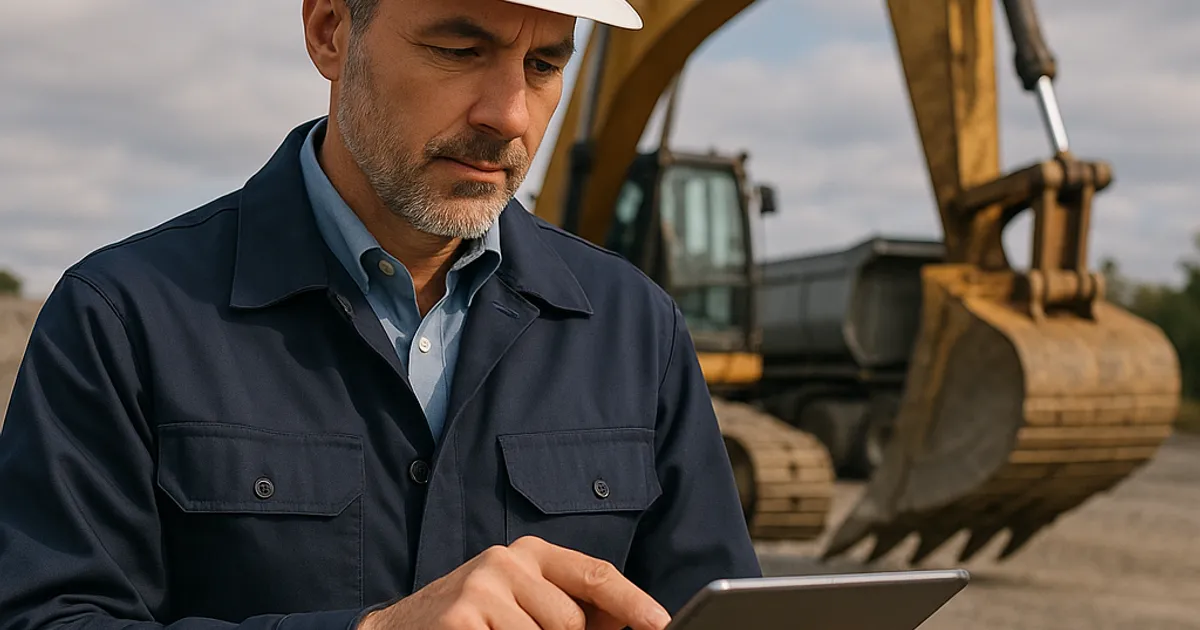
For decades, the trucking and excavating industry ran on handshakes, paper tickets, and institutional knowledge passed down from one operator to the next. Dispatchers memorized routes in their heads. Estimators eyeballed cubic yards with experience-honed intuition. Dirt disposal was a phone-tree problem solved by whoever you happened to know that week.
That world isn't gone—but it's changing fast. Artificial intelligence has moved from the laboratory into the cab, the job trailer, and the dispatch center. According to McKinsey & Company, AI-driven logistics optimization can reduce operational costs by 15–30% across heavy-equipment industries. For an excavating company running a $3 million annual operation, that's potentially $450,000 to $900,000 in recovered margin—every single year.
This article is a deep-dive into the specific AI tools, strategies, and platforms that are delivering real results for trucking and excavating businesses right now. We'll cover predictive maintenance, route optimization, AI-powered bidding, material matching, and much more. Whether you're running three dump trucks or a fleet of fifty excavators, there's something in here that will change how you think about your business.
What AI Actually Means for Earthwork Contractors
Before diving into applications, it's worth clearing up a common misconception: AI doesn't mean robots replacing your operators. In the context of trucking and excavating, AI refers to software systems that learn from data to make better predictions, automate repetitive decisions, and surface insights that humans can act on.
There are three primary categories of AI relevant to this industry:
- Machine Learning (ML): Algorithms trained on historical data to predict future outcomes. Examples include predicting equipment failure before it happens or estimating project costs based on thousands of past bids.
- Computer Vision: AI that interprets visual data from cameras. In excavating, this means machines that can measure stockpile volumes from drone footage or detect safety hazards on a job site in real time.
- Natural Language Processing (NLP): AI that understands and generates human language. Think AI assistants that can draft bid responses, summarize contract language, or answer customer inquiries automatically.
The construction and heavy-equipment sector has been historically slow to adopt technology, but that's shifting rapidly. The Associated General Contractors of America (AGC) reported in its Construction Technology Survey that over 58% of contractors plan to significantly increase technology investment over the next three years, with AI and machine learning topping the priority list.
The contractors who move early will gain a compounding advantage. The ones who wait will be competing with leaner, faster, better-informed rivals.
AI-Powered Route Optimization: Squeezing Every Mile
Fuel is typically the second-largest operating expense for a trucking company, trailing only labor. In 2024, diesel averaged $3.80–$4.20 per gallon nationally, and a Class 8 dump truck averages just 5–7 miles per gallon under load. On a 60-mile round trip with three loads per day, you're burning roughly 25–35 gallons per truck, per day. Multiply that across a 10-truck fleet running 250 days a year, and fuel alone costs $237,500–$367,500 annually.
AI route optimization attacks that number directly.
How Route Optimization AI Works
Modern route optimization platforms ingest dozens of variables simultaneously:
- Real-time traffic data and road closures
- Legal truck route restrictions (per FHWA regulations under 23 CFR Part 658)
- Weight restrictions by road and bridge (governed at the state DOT level)
- Job site gate hours and scheduling windows
- Fuel station locations and pricing
- Driver hours-of-service compliance under FMCSA regulations (49 CFR Part 395)
Platforms like Trimble, Samsara, and Verizon Connect use ML algorithms that continuously improve as they accumulate more data from your specific fleet. After 90 days of operation, these systems typically have enough pattern data to start making genuinely counterintuitive recommendations—routing trucks through what looks like a longer path because historical data shows it results in fewer delays.
Real-World Results
A mid-sized excavating company in Colorado piloting AI route optimization across 18 dump trucks reported a 12% reduction in total miles driven and an 8% reduction in fuel costs over six months. They also saw a 19% reduction in late arrivals to job sites, which had a downstream effect on project scheduling and client satisfaction scores.
For contractors working in dense urban markets—like those doing dirt exchange in Denver or managing fill material logistics in dirt exchange in Los Angeles—traffic complexity makes AI routing particularly valuable. A route that takes 22 minutes at 7 AM takes 55 minutes at 8:15 AM. AI systems model these patterns across thousands of historical trips and route accordingly.
Implementation Steps
- Audit your current routing: Log actual drive times vs. estimated times for 30 days to establish a baseline.
- Install ELD/telematics hardware: Most AI routing platforms require GPS telematics. Compliance with FMCSA's ELD mandate (49 CFR Part 395.8) means most fleets already have this hardware.
- Integrate dispatch software: Connect your telematics data to a routing platform like Samsara or Trimble TMS.
- Train dispatchers: AI recommendations are only as good as the humans who act on them. Budget 2–3 days of dispatcher training.
- Review and iterate: Set monthly KPI reviews for fuel consumption, miles driven, and on-time delivery rate.
Predictive Maintenance: Stopping Breakdowns Before They Start
Equipment downtime is one of the most expensive events in the excavating business. A single excavator sitting idle costs $1,500–$4,000 per day in lost productivity, not counting emergency repair costs and the ripple effect on project timelines. According to OSHA's construction safety data, equipment failure is also a leading contributing factor in heavy construction incidents—making predictive maintenance not just a financial issue but a safety imperative.
The Economics of Predictive vs. Reactive Maintenance
| Maintenance Type | Average Cost Per Event | Downtime Per Event | Failure Prevention Rate |
|---|---|---|---|
| Reactive (break-fix) | $8,000–$25,000 | 3–7 days | 0% |
| Preventive (scheduled) | $2,000–$5,000 | 4–8 hours | ~30% |
| Predictive (AI-driven) | $800–$2,500 | 1–3 hours | 70–85% |
Those numbers tell the story clearly. Predictive maintenance—where AI monitors machine health in real time and flags anomalies before they become failures—dramatically reduces both cost per event and frequency of unplanned downtime.
How It Works in Practice
Modern heavy equipment comes equipped with telematics systems that stream dozens of data points: engine temperature, hydraulic pressure, DEF fluid levels, idle time, fuel consumption ratios, vibration signatures, and more. AI platforms like Uptake, Trackunit, or Caterpillar's own Cat® Product Link analyze these streams against baseline performance models.
When a hydraulic pump starts showing a pressure signature that historically precedes failure by 180–220 operating hours, the system flags it and automatically generates a work order. Your mechanic replaces a $400 seal before it becomes a $12,000 pump replacement plus a crane to extract the machine from a 15-foot excavation.
Integrating Predictive Maintenance Into Your Operation
- OEM Telematics First: Start with the manufacturer's native telematics platform (Cat Product Link, Komatsu KOMTRAX, John Deere Operations Center). These systems are pre-calibrated to your specific equipment models.
- Set Alert Thresholds: Work with your mechanic to define acceptable operating ranges for your most critical machines. AI systems need human expertise to define what "normal" looks like for your specific use cases.
- Build a Maintenance Database: The more historical repair data you feed the system, the smarter it gets. Digitize your last 3–5 years of maintenance records to accelerate the ML model's learning curve.
- Create Feedback Loops: When the AI flags an issue and a mechanic confirms (or doesn't confirm) a problem, that feedback trains the model. Encourage mechanics to log outcomes every time.
AI in Estimating and Bidding: Winning More Work at Better Margins
Estimating is where fortunes are made and lost in the excavating business. Bid too high and you lose the job. Bid too low and you win a job that costs you money. Traditional estimating relies heavily on experienced estimators who carry years of pattern recognition in their heads—and when they leave, that knowledge walks out the door with them.
AI is beginning to change this in three significant ways.
1. Historical Data Analysis for Accurate Cost Modeling
AI estimating platforms ingest your historical project data—actual costs, actual hours, equipment utilization, material prices—and build predictive models that estimate future project costs with significantly higher accuracy than spreadsheet-based methods.
Companies using AI estimating tools report bid accuracy improvements of 18–27%, meaning fewer surprise overruns and more confident pricing. Platforms like HCSS HeavyBid and B2W Estimate are increasingly incorporating ML features that flag when a proposed bid falls outside the statistical range of similar completed projects.
2. Market Intelligence and Competitive Pricing
Some AI platforms now aggregate bid data from public procurement portals, DOT let data, and historical awarded contracts to give contractors a real-time view of competitive pricing in their market. This is particularly valuable for contractors pursuing public works projects, where awarded bid amounts are matters of public record.
For example, a contractor bidding on a grading project for a county road in Colorado could pull AI-aggregated data showing that similar scopes in that county have been awarded at $4.20–$5.10 per cubic yard over the past 18 months—giving them a defensible pricing target rather than a gut feel.
3. Automated Quantity Takeoffs
Drone photogrammetry combined with AI analysis is eliminating one of the most time-consuming parts of estimating: calculating earthwork quantities. A drone flight over a site that would take a survey crew two days and $3,000–$5,000 now takes 45 minutes and costs $200–$400 with platforms like DroneDeploy or Propeller. The AI processes the imagery into a 3D point cloud and automatically calculates cut/fill volumes with accuracy within 1–3% of traditional survey methods.
This isn't just faster—it fundamentally changes how many bids you can pursue. An estimator who used to do 8–10 detailed bids per month can now do 20–25, dramatically expanding your company's opportunity pipeline.
Material Matching and Dirt Exchange: AI Solving a $10 Billion Problem
Here's a problem every excavating contractor knows intimately: you're sitting on 5,000 cubic yards of clean structural fill that you need to get off your site, and three miles away, another contractor desperately needs 4,000 cubic yards of fill for a pad. Neither of you knows the other exists. You both haul your material 25 miles to a disposal site and pay a tipping fee, then the other contractor buys virgin fill from a quarry 30 miles in the opposite direction.
This happens thousands of times every day across the country. The EPA estimates that construction and demolition debris—including excavated soil—represents the largest component of total waste generation in the United States, at over 600 million tons per year. A significant portion of that is clean material that could be reused but isn't, because there was no efficient mechanism to connect supply with demand.
AI-powered material matching platforms are solving this problem at scale.
How AI Matching Works
The technology behind modern material matching platforms combines several AI capabilities:
- Geospatial Optimization: Algorithms identify the shortest-distance matches between material sources and demand locations, minimizing haul distance and cost.
- Material Classification: Based on contractor-submitted soil type, testing data, and intended use, the system filters matches by material suitability—ensuring clean structural fill doesn't get matched with a project that needs ASTM D2487-classified granular fill for specific bearing capacity requirements.
- Timing Coordination: AI systems factor in project schedules to match supply and demand windows, preventing situations where material is available three weeks before it's needed.
- Regulatory Compliance Screening: Sophisticated platforms screen material origin data against EPA and state environmental agency records to flag any sites with potential contamination history before a match is confirmed.
DirtMatch is purpose-built to solve exactly this problem for earthwork contractors. The platform connects contractors who have excess dirt, rock, fill, and aggregate with projects that need those materials—dramatically reducing haul costs, disposal fees, and the environmental impact of unnecessary trucking. For contractors in high-cost urban markets, learn how DirtMatch works to understand how the matching algorithm factors in material type, quantity, location, and project timing to generate the most cost-effective connections.
The Financial Impact
The numbers are compelling. Consider a contractor excavating a commercial foundation in Seattle who generates 3,200 cubic yards of clean glacial till:
- Without matching: Dispose at $18/CY tipping fee = $57,600 disposal cost + 45-mile round-trip hauling
- With AI matching: Material matched to a fill project dirt exchange in Seattle 8 miles away; tipping fee eliminated; hauling cost reduced by 65%
- Net savings: $40,000–$50,000 on a single project
Multiply that across a contractor doing 12–15 similar projects per year, and you're talking about a transformative impact on annual profitability.
AI for Fleet Management and Dispatch Optimization
Running a fleet of dump trucks is a complex logistics problem that changes hour by hour. A truck finishes its load early. A job site goes on hold because the inspector hasn't signed off. Another site calls in urgent needing two more trucks immediately. Traditional dispatch manages this chaos reactively. AI dispatch manages it proactively.
Dynamic Load Balancing
AI dispatch systems continuously model the entire fleet state—where every truck is, what it's carrying, where it needs to go, and what the optimal next assignment is—and update assignments dynamically as conditions change. This is similar to how ride-share platforms dispatch drivers, except the variables are more complex: load capacity, material type, site access restrictions, driver certification, and equipment compatibility all factor into the algorithm.
Companies implementing AI dispatch typically see:
- 12–18% increase in loads completed per truck per day
- 8–15% reduction in empty miles (trucks running without a load)
- 20–30% reduction in dispatcher workload, allowing one dispatcher to manage significantly more trucks
Driver Performance Monitoring and Coaching
AI-powered telematics don't just track trucks—they coach drivers. Systems analyze driving behavior patterns: hard braking, excessive idling, speeding, aggressive cornering. They generate driver scorecards and, in some implementations, deliver real-time in-cab coaching (a gentle chime when the system detects the driver is about to brake harder than necessary, for example).
The ROI here is multifaceted: safer driving reduces accident liability, gentler operation extends equipment life, and reduced idling saves fuel. One national trucking company reported that driver coaching AI reduced accident-related costs by 34% over 18 months.
Find or Post Dirt, Rock & Aggregate
Join thousands of contractors using DirtMatch to buy, sell, and exchange earthwork materials.
Try DirtMatch FreeAI on the Job Site: Safety, Productivity, and Site Monitoring
The job site itself is becoming an AI-monitored environment, and the results for safety and productivity are significant.
Computer Vision for Safety Monitoring
AI camera systems can now monitor job sites in real time and automatically detect:
- Workers not wearing required PPE (hard hats, high-visibility vests, safety glasses)
- Personnel entering equipment exclusion zones
- Potential struck-by hazards when equipment is operating near workers
- Unauthorized site access after hours
These systems generate automatic alerts and log violations for safety management review. Given that OSHA reports that struck-by incidents account for over 10% of construction fatalities, real-time AI monitoring represents a meaningful intervention.
From a liability perspective, the documentation these systems provide is also valuable. In the event of an incident, AI-monitored sites have timestamped video evidence of safety protocols in effect—a significant asset in litigation defense.
Drone-Based Progress Monitoring
Weekly drone flights analyzed by AI provide project managers with accurate volumetric progress data—how much material has been moved, how much remains, and whether the project is tracking to schedule. This replaces expensive survey crews and gives project managers data-driven answers to questions that previously required educated guesses.
For large earthwork projects—highway embankments, reservoir construction, large commercial site grading—this capability is transformative. Project managers can compare current earthwork quantities against the project schedule and budget forecast, identify variance early, and take corrective action before small schedule slips become expensive overruns.
AI-Powered Customer Communication and CRM
It might seem peripheral to the core business, but customer communication is where many earthwork contractors leak significant revenue. Slow bid responses, missed follow-up calls, poor documentation of client history—these translate directly into lost business and lower client retention.
AI-Assisted Bid Writing
Large language model AI tools (like those built on GPT-4 technology) can dramatically accelerate the bid writing process. An estimator who has calculated the numbers can feed those figures into an AI writing tool along with project specifications and generate a professional, detailed bid document in minutes rather than hours. This isn't about replacing the estimator's expertise—it's about removing the writing bottleneck so that expertise can be deployed on the next opportunity faster.
CRM with AI Intelligence
Modern CRM platforms like Salesforce and HubSpot now include AI features that:
- Score leads by likelihood to close based on historical patterns
- Automatically log customer interactions from email and phone
- Suggest optimal follow-up timing based on client behavior
- Identify at-risk client relationships before they churn
For a company doing $5 million in annual revenue with a 20% gross margin, retaining even one additional major client per year through better relationship management could mean $200,000–$500,000 in preserved revenue.
Implementing AI: A Practical Roadmap for Excavating and Trucking Companies
Knowing AI offers potential is one thing. Actually implementing it in a busy contracting business is another. Here's a practical roadmap.
Phase 1: Foundation (Months 1–3)
Goal: Get your data house in order.
- Implement or optimize your telematics system across all equipment
- Digitize historical project cost data (last 3–5 years minimum)
- Migrate dispatch from whiteboards/spreadsheets to a digital platform
- Set baseline KPIs: fuel cost per mile, cost per operating hour, average bid-to-win ratio, on-time delivery rate
Estimated investment: $15,000–$40,000 depending on fleet size and current technology state
Phase 2: Quick Wins (Months 3–6)
Goal: Deploy AI tools that deliver fast, measurable ROI.
- Activate AI route optimization in your telematics platform
- Enroll in an AI-powered material matching platform to reduce disposal costs
- Implement driver coaching features in your telematics system
- Explore drone photogrammetry for your next 3–5 takeoffs
Estimated investment: $8,000–$20,000 annually in SaaS subscriptions Expected ROI: 200–400% in Year 1 for most operations
Phase 3: Advanced Integration (Months 6–18)
Goal: Connect systems and leverage AI across the full operation.
- Integrate estimating software with CRM for closed-loop bid analytics
- Deploy computer vision safety monitoring on active job sites
- Implement predictive maintenance across your heavy equipment fleet
- Explore AI-powered scheduling and project management tools
Estimated investment: $25,000–$75,000 (varies significantly by company size)
Phase 4: Competitive Differentiation (Month 18+)
Goal: Use AI-derived insights as a competitive advantage in the market.
- Use AI market intelligence to inform strategic pricing
- Develop data-driven case studies demonstrating AI-enabled cost savings to clients
- Recruit technology-forward estimators and project managers
- Explore AI-powered subcontractor and supplier performance scoring
ROI Comparison by AI Application
| AI Application | Avg. Annual Investment | Avg. Annual Savings | Typical Payback Period |
|---|---|---|---|
| Route Optimization | $3,000–$8,000 | $15,000–$60,000 | 1–3 months |
| Predictive Maintenance | $5,000–$15,000 | $30,000–$120,000 | 2–4 months |
| AI Estimating Tools | $4,000–$12,000 | $20,000–$80,000 | 2–6 months |
| Material Matching | $1,200–$3,600 | $20,000–$200,000 | Immediate |
| AI Safety Monitoring | $8,000–$25,000 | $15,000–$75,000 | 3–9 months |
| AI Dispatch | $6,000–$18,000 | $25,000–$90,000 | 2–5 months |
Overcoming Resistance: Getting Your Team on Board
The biggest barrier to AI adoption in trucking and excavating isn't the technology—it's human resistance. Operators who've run equipment for 20 years can feel threatened by systems that seem to question their judgment. Dispatchers worry about being replaced. Estimators guard their bid methodologies as proprietary expertise.
Reframe AI as a Tool, Not a Replacement
The most effective companies position AI as a system that makes experienced people more powerful, not a system that replaces them. A driver coaching system doesn't tell your best driver he's bad at his job—it confirms he's in the top percentile and makes it easier to coach newer drivers up to his standard. An AI estimating tool doesn't replace your senior estimator's judgment—it gives him 40% of his time back so he can focus on the complex bids that really require his expertise.
Change Management Best Practices
- Start with champions: Identify 2–3 early adopters on your team who are curious about technology. Let them pilot new tools and become internal advocates.
- Be transparent about goals: If the goal is to cut costs, say so—but also explain what that means for job security. "We want to run more trucks with the same dispatch team" is more reassuring than unexplained new monitoring software.
- Celebrate wins publicly: When AI-driven route optimization saves $8,000 in a month, make sure the whole company knows. Connect the technology adoption to real business outcomes that everyone benefits from.
- Involve operators in tool selection: When operators have input on which telematics features get activated, they have ownership over the outcome.
According to research from the Construction Industry Institute, projects with active employee involvement in technology adoption achieve 3x the productivity improvement of top-down mandated rollouts.
The Future Landscape: Where AI Is Taking the Industry
The applications described above are available today. But the trajectory of AI development suggests the next 5–10 years will bring changes that are even more fundamental.
Autonomous Hauling
In mining and large-scale earthmoving operations, autonomous haul trucks are already operating commercially. Caterpillar's autonomous haul system has moved more than 3 billion tonnes of material worldwide. While fully autonomous highway trucking remains years away from widespread deployment, autonomous on-site hauling within confined construction sites is much closer to practical reality.
AI-Designed Earthwork Plans
Generative AI systems are beginning to assist civil engineers in designing site grading plans that minimize earthwork volumes by optimizing cut/fill balance across the entire site. An AI that can analyze site topography, soil conditions, and project requirements to generate a grading plan that moves 15% less material than a human-designed plan is not a hypothetical—it's in early commercial deployment today.
Real-Time Material Cost Intelligence
As platforms like DirtMatch accumulate transaction data across thousands of earthwork projects, they build a real-time picture of material supply and demand by region. That data becomes increasingly valuable for pricing decisions, project planning, and market intelligence—creating a compounding advantage for platform participants that grows over time.
Contractors operating in high-growth markets like dirt exchange in San Francisco or dirt exchange in Boston are already finding that real-time visibility into regional material availability is changing how they approach project planning and pricing.
Getting Started: Your First Steps Today
The gap between contractors who embrace AI and those who don't is going to widen significantly over the next 36 months. Here's how to start closing that gap this week:
This week:
- Schedule a demo with one AI route optimization platform (Samsara, Trimble, or Verizon Connect)
- Pull your last 12 months of fuel costs and equipment repair logs to establish your baseline
- Sign up for a material matching platform to reduce disposal costs on your next project
This month:
- Identify your highest-cost pain point (fuel, equipment downtime, bid accuracy, or material disposal) and find the AI tool that addresses it specifically
- Talk to your equipment OEM rep about activating telematics features you're already paying for but not using
- Attend a webinar or workshop from the Associated General Contractors on construction technology adoption
This quarter:
- Complete Phase 1 of the implementation roadmap above
- Set measurable AI ROI targets for the next 6 months
- If you're dealing with excess fill material or need fill for upcoming projects, get started with DirtMatch and see how the platform can immediately reduce your material logistics costs
The contractors who will dominate their local markets five years from now are the ones making these decisions today. The technology is proven, the ROI is documented, and the implementation pathways are clear. The only question is whether you'll lead the change or respond to it.