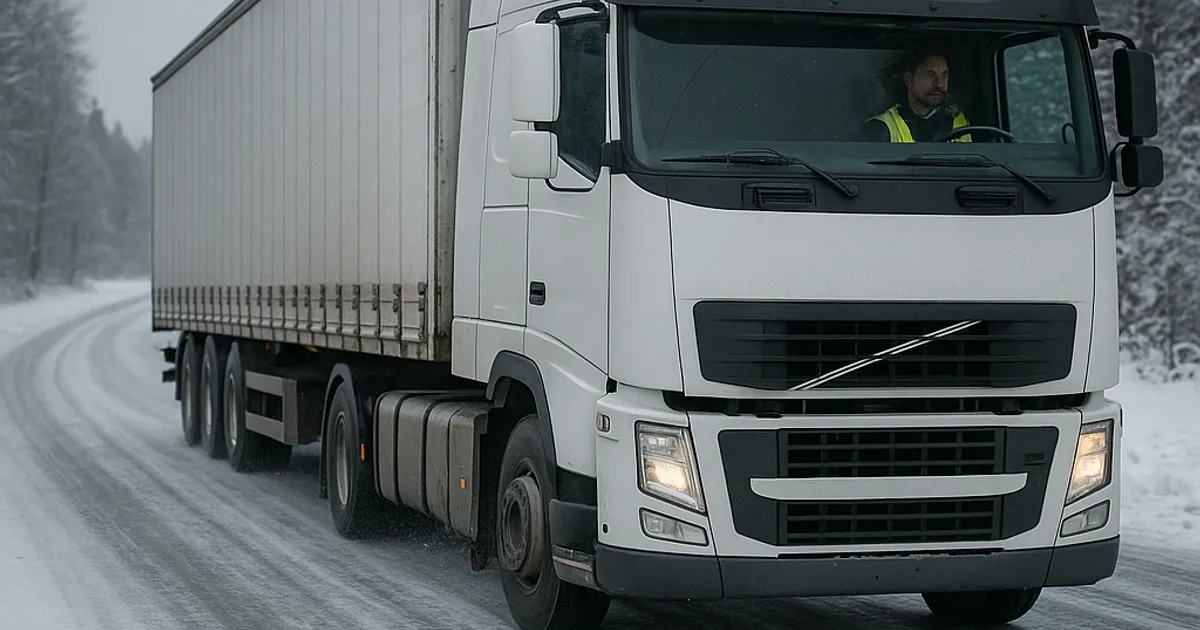
Winter doesn't stop earthwork. Grading crews, dump truck operators, and aggregate haulers across the country push through freezing temperatures and icy conditions to keep construction timelines moving. But operating a fully loaded semi or dump truck on black ice is a fundamentally different challenge than summer hauling — one that demands specialized knowledge, upgraded equipment, and disciplined technique.
According to the Federal Motor Carrier Safety Administration (FMCSA), commercial motor vehicle crashes increase significantly during winter months, with ice and snow cited as contributing factors in roughly 17% of all large truck fatal crashes annually. For earthwork contractors hauling dirt, rock, and aggregate materials, the stakes are especially high: a loaded dump truck can weigh 80,000 pounds at maximum gross vehicle weight — and that kind of momentum on a slick road surface can be catastrophic.
This comprehensive guide walks through everything operators and fleet managers need to know about safely hauling heavy loads through icy conditions, from pre-trip equipment checks to regulatory compliance and route planning strategies.
Why Icy Roads Are Especially Dangerous for Heavy Trucks
Passenger vehicle drivers often underestimate how dramatically icy conditions affect heavy trucks. The physics are sobering. A fully loaded dump truck traveling at 55 mph on dry pavement requires approximately 196 feet to stop. On ice, that stopping distance can increase by 10 times or more, stretching to nearly 2,000 feet — more than six football fields.
Several factors compound the danger for heavy vehicles specifically:
The Load Factor
Weight distribution plays a critical role in traction and braking. A loaded aggregate truck puts more downward force on rear drive axles, which can actually improve traction at low speeds. However, that same weight creates enormous kinetic energy that anti-lock braking systems (ABS) may struggle to dissipate on glare ice. An empty or partially loaded truck is often more dangerous on ice because the rear axles lose traction more easily, making jackknifing more likely.
Black Ice and Surface Deception
Black ice — a thin, transparent layer of ice that makes road surfaces appear merely wet — is the silent killer for commercial drivers. It forms most frequently when temperatures hover between 32°F and 20°F, particularly on bridges, overpasses, shaded road sections, and areas near bodies of water. According to data from the National Highway Traffic Safety Administration (NHTSA), ice and sleet are responsible for more than 1,500 fatalities and 116,000 injuries per year across all vehicle categories in the United States.
Trailer Dynamics and Jackknifing
Articulated trucks — including semi-trucks pulling belly-dump trailers or end-dump trailers common in earthwork operations — face the additional risk of jackknifing. When rear drive wheels lock or lose traction before the front steer axle, the trailer can push the cab into a dangerous fold. Understanding how to brake progressively and maintain axle alignment is essential for drivers operating any multi-unit combination vehicle on ice.
Pre-Trip Inspection Protocols for Winter Conditions
Before any wheel turns on an icy day, a thorough pre-trip inspection is non-negotiable. Under 49 CFR Part 396, commercial vehicle drivers are federally required to perform a pre-trip inspection before every trip. In winter conditions, that standard inspection must be expanded significantly.
Brake System Check
Brakes are your most critical safety system on ice. Check all of the following:
- Air brake pressure build-up time: Should reach 100 psi within 3 minutes of engine start
- Low air warning alarm: Must activate at or above 60 psi
- Brake stroke adjustment: Measure pushrod travel on each brake chamber; out-of-adjustment brakes are one of the most common roadside violations
- ABS function lights: Ensure all ABS indicator lights cycle properly on startup
- Brake lining thickness: Replace if lining is at or below 1/4 inch on steering axles or 1/4 inch on other axles per FMCSA guidelines
Tire Inspection
Tires are your only contact patch with the road surface. In icy conditions:
- Check tread depth: Federal minimums are 4/32" on steer axles and 2/32" on other axles, but for winter operations, many safety-conscious fleets set internal standards of 6/32" or better
- Inspect for sidewall cracks, bulges, or embedded debris
- Check tire pressure: Cold temperatures reduce inflation pressure by approximately 1 psi for every 10°F drop in temperature; underinflated tires reduce traction and handling
- Verify that mud and snow (M+S) rated tires or dedicated winter tires are installed if required by your operating state
Chains and Traction Devices
Many mountain states and winter-weather states require chains or equivalent traction devices under specific conditions. Requirements vary significantly by state:
| State | Chain Law Trigger | Applicable Vehicles |
|---|---|---|
| California | R-2 or R-3 conditions declared | All commercial vehicles |
| Colorado | Traction Law or Chain Law | CMVs over 26,000 lbs |
| Washington | Requirement posted by WSDOT | All vehicles on designated routes |
| Oregon | Carry requirement Oct–Apr | Certain CMV configurations |
| Montana | Advisory or mandatory by MDOT | All vehicles |
For contractors operating in the Pacific Northwest — including those doing dirt exchange in Seattle — monitoring the Washington State DOT chain law status is a daily winter responsibility. Failing to comply can result in fines exceeding $500 and liability exposure in the event of a crash.
Lights, Wipers, and Defroster
- Test all lighting: headlights, brake lights, turn signals, and clearance lights
- Ensure windshield wipers are in good working order and topped off with freeze-rated washer fluid (rated to at least -20°F)
- Confirm defroster is functional on all zones
- Clear all ice and snow from the entire truck and trailer — in many states, failing to clear ice from a commercial vehicle is a moving violation
Speed Management: The Cornerstone of Icy Road Safety
No single factor contributes more to winter truck crashes than excessive speed for conditions. Posted speed limits represent safe speeds for ideal dry conditions — not icy pavement. FMCSA regulations under 49 CFR 392.14 explicitly state that drivers must reduce speed when hazardous conditions exist and, when conditions are sufficiently dangerous, must stop until it is safe to proceed.
Calculating Safe Speeds on Ice
A practical starting framework for commercial drivers:
- Light frost or freezing drizzle: Reduce speed by 30-40%
- Packed snow on pavement: Reduce speed by 40-50%
- Glare ice or black ice: Reduce speed by 50-70% or more
- Bridges and overpasses in any icy condition: Additional 10-15% reduction beyond the above
For a driver normally running 55 mph on a rural highway, glare ice conditions should trigger a reduction to 17-28 mph. This feels painfully slow to productivity-focused operators, but it is the appropriate and legally defensible speed.
Speed Management for Loaded vs. Empty Trucks
As noted earlier, load state significantly affects handling. The earthwork industry presents a unique challenge because dump trucks and aggregate haulers cycle between fully loaded and empty conditions multiple times per day. Drivers must recalibrate their speed and braking judgment at every load/unload cycle.
Loaded trucks: Higher rear axle traction, but dramatically longer stopping distances. Maintain generous following distance.
Empty trucks: Lighter weight reduces rear axle downforce, increasing skid risk. Some operators counterintuitively find empty hauls more dangerous on ice than loaded ones.
The Three-Second Rule Becomes the Ten-Second Rule
In normal conditions, a three-second following distance is the minimum standard for commercial vehicles. On ice, safety experts and organizations like the Commercial Vehicle Safety Alliance (CVSA) recommend extending following distance to 8-10 seconds minimum — and even further when descending grades or approaching intersections.
Braking Techniques for Heavy Trucks on Ice
Proper braking technique on icy roads is counter-intuitive for drivers trained primarily in dry-weather operations. The goal is always to avoid wheel lockup, which eliminates steering control and dramatically increases stopping distance.
Understanding ABS vs. Non-ABS Systems
Modern commercial vehicles built after March 1, 1998, are required to have ABS on tractors, and trailers built after March 1, 1998, must also have ABS. However, much of the aging fleet in earthwork and construction operations may have older equipment without full ABS coverage.
With ABS: Apply firm, steady pressure to the brake pedal and let the system modulate pressure automatically. Do NOT pump ABS brakes — doing so defeats the system. Maintain steering control while braking.
Without ABS: Apply threshold braking — apply pressure just to the point of wheel lockup, then ease off slightly. This technique requires significant skill and practice. Some experienced drivers prefer a squeeze-and-ease cadence. Pumping brakes is appropriate only on non-ABS systems.
Engine Braking and Jake Brakes on Ice
Engine compression brakes (commonly called Jake Brakes) are powerful deceleration tools on dry roads, but they can be dangerous on ice. Applying engine braking to drive axles on slick surfaces can cause rear wheel lockup and jackknifing — particularly on empty or lightly loaded vehicles.
Many jurisdictions post signs prohibiting Jake Brake use in urban areas due to noise, but on icy rural routes, the prohibition should be self-imposed: use engine braking sparingly, in low gear, and only when the vehicle is straight — never while turning or on a curve.
Downhill Grade Management
Desending grades on ice represents the highest-risk scenario for heavy trucks. The approach:
- Check your grade: Know your route; identify grades over 6% in advance
- Gear down before the descent: Select a gear that allows engine braking to control speed without service brake overuse
- Check brake temperature: Use brake check areas at the top of long grades
- Maintain a steady speed: Don't let gravity accelerate you beyond your target speed
- Runaway truck ramps: Know their locations on your route — they are a legitimate, no-shame safety option
Load Securement and Weight Distribution in Winter
The interaction between load weight, distribution, and winter traction is one of the most underappreciated aspects of cold-weather heavy truck operation. For earthwork contractors hauling fill dirt, crushed rock, or aggregate materials, load management in winter requires extra attention.
Federal Load Securement Standards
All cargo carried on commercial vehicles must comply with 49 CFR Part 393, Subpart I, which governs cargo securement. In winter conditions, specific considerations include:
- Frozen material bridging: Frozen dirt or aggregate can bridge across a dump body, creating a false appearance of an empty bed. When the load releases during transit, the sudden weight shift can destabilize the truck
- Ice accumulation on tarps and tarping systems: Ice adds weight and can compromise tarp integrity; tarps must be re-inspected after any icing event
- Wet material weight: Material collected in wet or snowy conditions may significantly exceed dry-weight calculations; overloading in these scenarios is a common compliance issue
Optimal Load Distribution for Winter Traction
For rear-axle drive trucks, keeping the load distributed toward the rear of the dump body improves rear axle downforce and traction. However, this must be balanced against rear axle weight limits. Work with your loader operators to develop a consistent loading pattern that maximizes rear axle traction without exceeding legal axle weight limits.
For contractors managing multiple haul sites and needing to optimize logistics around seasonally affected routes, DirtMatch provides a platform that helps earthwork contractors connect load sources with nearby projects — reducing the distance trucks must travel on hazardous winter roads and improving overall hauling efficiency during difficult weather windows.
Route Planning and Weather Monitoring for Winter Hauling
Effective winter operations begin long before a truck leaves the yard. Proactive route planning and real-time weather monitoring are as important as any in-cab driving technique.
State DOT Resources and Road Condition Systems
Every major trucking state maintains real-time road condition systems that commercial operators should bookmark and monitor daily:
- Colorado: CDOT's COtrip.org provides real-time road conditions, camera feeds, and chain law status — critical for contractors doing dirt exchange in Denver or hauling through mountain corridors
- Washington: WSDOT's TripCheck system covers all major routes
- California: Caltrans Road Conditions (1-800-427-7623) and QuickMap app
- Colorado and Mountain West: Chain law R-values are posted on state DOT websites and updated in real time
Route Optimization for Winter Safety
When planning winter haul routes, evaluate:
- Grade profiles: Use topographic tools to identify grades over 6% on your route and plan for them
- Bridge and overpass frequency: These freeze before road surfaces; high-bridge routes are higher risk
- Shade exposure: North-facing road segments in mountain terrain may remain icy hours after sunny sections thaw
- Alternate routes: Always identify a backup route that avoids the most challenging terrain
- Timing: Schedule hauls during peak daytime warming when possible; dawn and dusk hours often present the worst ice conditions as temperatures fluctuate around freezing
Using Technology for Real-Time Decisions
Modern fleet telematics platforms provide real-time speed alerts, hard-braking events, and geofencing capabilities that help dispatchers monitor driver behavior during winter hauls. Leading systems like Samsara, Verizon Connect, and Motive offer temperature overlays and road condition integrations that allow dispatchers to make real-time route adjustments.
For earthwork fleets managing multiple trucks across regional haul corridors, coordinating project timing around weather windows is both a safety imperative and a business necessity. Platforms like DirtMatch Pro give contractors enhanced tools to manage project connections and logistics — helping teams make smarter decisions about when and where to haul during challenging winter conditions.
Regulatory Compliance: Federal and State Winter Driving Rules
Compliance with winter driving regulations is not optional — and the regulatory landscape for commercial vehicles is more complex than many operators realize.
FMCSA Hours of Service Exemptions
The FMCSA provides a specific adverse driving conditions exemption under 49 CFR 395.1(b)(1) that allows commercial drivers to extend their driving window by up to 2 hours when encountering unexpected adverse conditions (including ice and snow) that were not apparent at the trip's start. This exemption does not permit violation of the 11-hour driving limit — it only provides a 2-hour buffer in the on-duty calculation.
Importantly, this exemption applies to conditions encountered en route — it cannot be used to extend a schedule based on known winter conditions at trip planning time.
State-Specific Tire and Chain Requirements
Beyond chain laws, several states mandate specific tire standards for commercial vehicles in winter:
- Washington: Requires trucks on designated routes to carry chains October through March
- Oregon: Requires commercial vehicles to carry chains during November through March in mountain passes
- Colorado: Chain law violations carry fines up to $650 for commercial vehicles, plus potential liability for road closures
- California: R-1 through R-3 chain requirements apply to commercial vehicles based on severity; R-3 requires chains on all wheels
Weight Restrictions and Winter Road Bans
Many states impose seasonal weight restrictions on roads during winter and spring thaw periods, when frost coming out of the ground can dramatically reduce road load-bearing capacity. These restrictions — sometimes called "frost laws" or "spring weight restrictions" — can reduce legal axle weights by 20-35% on affected roads.
For earthwork contractors, these restrictions directly affect hauling capacity and project scheduling. States including Minnesota, Michigan, Wisconsin, and many others post seasonal weight restriction maps that operators must monitor. Violating these restrictions can result in fines of $50-$200 per pound of overweight violation in some states.
Find or Post Dirt, Rock & Aggregate
Join thousands of contractors using DirtMatch to buy, sell, and exchange earthwork materials.
Try DirtMatch FreeWinter Training and Driver Certification Programs
Technical skill development is the foundation of safe winter operations. Drivers who have only trained or worked in warm-weather environments may lack the intuitive feel for how a heavy vehicle behaves on ice.
Available Training Programs
Smith System Driver Improvement: The Smith System is widely used by commercial fleets and covers the cognitive aspects of hazard anticipation, including winter conditions.
CVSA Operation Safe Driver Week: The Commercial Vehicle Safety Alliance runs education campaigns focused on driver behavior, with specific winter driving content.
State-Specific CDL Winter Training: Several states, including Minnesota and Wisconsin, offer supplemental winter driving curriculum through their CDL licensing programs.
Skid Pad Training: Many regional truck driving schools offer controlled skid pad courses where drivers can experience and recover from skids in a safe environment. These programs dramatically improve driver confidence and skill.
Building an Internal Winter Safety Culture
Fleet managers and company owners play a critical role in establishing a culture where drivers feel empowered to slow down, pull over, or refuse a run when conditions are too dangerous. Key practices:
- Pre-season safety meetings: Hold annual winter readiness briefings before the first freeze
- No-fault delay policies: Explicitly communicate that drivers will not be penalized for weather delays
- Incentive programs: Reward clean safety records and incident-free winter seasons
- Anonymous reporting: Give drivers a way to report equipment issues or unsafe dispatch pressure without fear of retaliation
Companies that invest in driver training see measurable returns. According to industry research, every $1 invested in driver safety training returns an average of $3-$5 in reduced crash costs, insurance savings, and productivity improvements.
Equipment Upgrades and Technology for Winter Operations
Beyond proper technique, equipment investments can significantly improve safety margins for winter truck operations.
Winter Tire Technology
The debate between all-season, M+S-rated, and dedicated winter tires is settled for serious winter operators: dedicated winter tires outperform all-season tires in sub-freezing conditions by significant margins. Modern winter tires use silica-infused compounds that remain pliable at low temperatures, providing superior grip compared to all-season rubber that stiffens and hardens when cold.
Cost consideration: A set of winter steer tires for a Class 8 truck runs approximately $400-$700 per tire, making a full winter tire changeover a significant investment. However, the cost must be weighed against crash costs, which average $200,000+ for a property-damage-only commercial truck accident and exceed $1 million when injuries are involved.
Automatic Tire Chain Systems
Automatic tire chain systems — including brands like Onspot and Pewag — allow drivers to engage traction devices without leaving the cab. These systems deploy spinning chain assemblies against drive tires at the push of a button. While they do not provide the same level of traction as full manual chains on all wheels, they significantly improve traction for the majority of winter conditions and eliminate the safety risk of roadside chain installation.
System costs range from $1,500-$3,000 per axle installed, with most fleets targeting drive axles first.
Electronic Stability Control (ESC)
Electronic Stability Control systems, which became mandatory on new tractors in 2017 under FMCSA regulations, use sensors to detect and mitigate rollover and jackknife events by selectively applying brakes and reducing engine torque. Fleets operating pre-2017 equipment should evaluate aftermarket ESC solutions, particularly for vehicles operating on steep or curvy winter routes.
Heated Mirror and Camera Systems
Visibility is severely compromised in winter conditions. Heated side mirrors and backup cameras with integrated heating elements maintain clear sightlines in snowing and icing conditions. For dump trucks and end-dump trailers — common in earthwork and aggregate operations — rear visibility during reversing maneuvers is critical year-round but especially so in winter when mirrors can ice over rapidly.
Managing Winter Earthwork Projects: Scheduling and Logistics
Safety and productivity in winter earthwork operations are not opposing forces — they are complementary. Smart scheduling and logistics management reduces exposure to the most dangerous winter driving conditions while maintaining project momentum.
Weather Window Hauling
In cold-weather regions, experienced earthwork contractors develop a discipline of "weather window hauling" — concentrating haul operations during the warmest and safest periods of each day and pausing during the highest-risk windows. A typical strategy:
- Hold operations: When temperature is below 20°F and precipitation is active
- Cautious operations: When temperature is 20-32°F with no active precipitation; reduced speed protocols in effect
- Normal operations: When temperature is above 32°F and road surfaces are cleared
This approach requires flexibility in project scheduling and close communication between site managers, dispatch, and drivers. It also requires that haul contracts include weather-delay provisions so contractors are not penalized for safety-driven slowdowns.
Reducing Haul Distances to Minimize Winter Exposure
One of the most effective risk-reduction strategies in winter earthwork operations is minimizing haul distances. Shorter hauls mean less time on icy roads, fewer grade changes, and more frequent load/unload cycles that allow drivers to reassess conditions continuously.
For contractors looking to source fill dirt, aggregate, or rock materials closer to project sites during winter months, DirtMatch connects earthwork professionals with local material sources and project opportunities — helping teams find the closest possible haul routes and reducing winter road exposure significantly. Understanding how DirtMatch works can help fleet managers build smarter, safer winter hauling strategies by matching loads with nearby sources rather than running long-haul routes across hazardous terrain.
Communication Protocols During Winter Operations
Establish clear communication check-in protocols for all winter hauls:
- Drivers check in with dispatch at each load and unload
- Immediate notification required for any condition change (deteriorating ice, unexpected closures)
- Two-way communication maintained at all times; no winter haul in dead zones without a check-in plan
- Emergency contact information posted in every cab
What To Do When Things Go Wrong: Emergency Protocols
Even with perfect preparation and technique, winter road incidents happen. Having clear emergency protocols in place determines whether a close call becomes a controllable situation or a catastrophe.
Skid Recovery Techniques
Rear skid (oversteer): If the rear of the truck begins to swing out, steer in the direction of the skid (counter-steer) while easing off the throttle. Avoid braking during a rear skid — it accelerates the rotation. This maneuver is extremely difficult with a trailer attached and is best prevented by smooth, gradual inputs at all times.
Front skid (understeer): If the front wheels lose traction and the truck continues straight despite steering input, ease off the throttle, release braking pressure, and allow the front wheels to regain traction before reapplying steering. Do not jerk the wheel.
Full jackknife: If a jackknife develops, immediately release the brake and attempt to straighten the trailer. If straightening is impossible and a collision is unavoidable, steer toward the least dangerous impact surface. A ditch is almost always better than oncoming traffic.
Controlled Stops and Pullover Procedures
When conditions deteriorate beyond safe operating thresholds, pulling over safely is the correct decision — always. Procedure:
- Signal your intent early and begin reducing speed gradually
- Choose a pull-off that is well away from the travel lane; a closed weigh station, truck stop, or wide road shoulder with visible rumble strips
- Engage four-way flashers and deploy reflective triangles per 49 CFR 392.22 (within 10 minutes of stopping, at 100, 100, and 200 feet)
- Notify dispatch of your location and situation
- Do not re-enter traffic until you can safely do so
Post-Incident Reporting
All incidents — including near-misses, skids, and unplanned stops due to conditions — should be documented through your company's safety reporting system. This data is invaluable for improving training, identifying high-risk routes and conditions, and demonstrating due diligence in the event of regulatory review.
Insurance, Liability, and Documentation for Winter Operations
From a business risk perspective, winter truck operations carry elevated insurance implications that fleet managers must understand.
Commercial Truck Insurance and Winter Risk
Commercial trucking insurance premiums are heavily influenced by loss history, and winter-related incidents are among the most common claim types. Carriers operating in high-snowfall regions should:
- Review their policy for adverse weather exclusions or special conditions
- Confirm that their cargo coverage addresses weather-related damage (including frozen material shifts)
- Verify that their general liability coverage extends to third-party property damage caused by ice dislodged from vehicles
Most commercial trucking policies require that operators follow all applicable laws and regulations — meaning a chain law violation at the time of an incident could constitute a coverage exclusion.
Documentation Best Practices
Maintain thorough records to establish that winter operations were conducted safely and in compliance:
- Pre-trip inspection reports (DVIRs) completed and retained for every winter trip
- Weather condition logs at dispatch time
- Driver hours of service logs with adverse condition exemption notation where used
- Chain installation records for applicable jurisdictions
- Maintenance records showing tire condition and brake inspection at season start
For contractors navigating the complexities of winter earthwork operations while managing project bids and material sourcing, getting connected with the right regional networks matters. Earthwork professionals working in winter-heavy markets like dirt exchange in Denver or dirt exchange in Boston can benefit from platforms that help them find flexible project opportunities that work around weather constraints — keeping revenue flowing even when hauling conditions force temporary pauses.
Building a Winter-Ready Heavy Truck Fleet: Cost Summary
For fleet managers evaluating their winter readiness investment, the following cost estimates provide a practical planning framework:
| Upgrade/Investment | Per-Truck Cost | Priority |
|---|---|---|
| Winter steer tires (2) | $800–$1,400 | High |
| Full winter tire set (all axles) | $3,000–$8,000 | Medium-High |
| Automatic tire chain system (drive axles) | $3,000–$6,000 | High |
| Manual chains (full set, per truck) | $400–$900 | Essential |
| Heated mirror upgrade | $200–$600 | Medium |
| Backup camera with heat element | $300–$800 | Medium |
| Telematics/fleet monitoring upgrade | $50–$150/month | High |
| Annual winter driver training | $100–$400/driver | High |
| ESC aftermarket installation (pre-2017) | $2,000–$5,000 | Medium |
For a typical 10-truck earthwork fleet, a comprehensive winter safety upgrade program might cost $15,000–$50,000 — a significant but justifiable investment when weighed against the cost of a single serious winter incident.
Conclusion: Making Winter Hauling a Strength, Not a Weakness
For earthwork contractors, winter hauling capability is a genuine competitive advantage. Companies that invest in proper equipment, training, and protocols can continue winning and executing projects through the coldest months — while competitors who haven't prepared are forced to pause or limit operations.
The key principles are consistent: slow down for conditions, never exceed your vehicle's capability on ice, maintain equipment to the highest winter standards, and build a safety culture that empowers drivers to make the right call even when it means a delay.
For contractors looking to maximize their project opportunities during winter months — including finding material sources and dump sites closer to home to reduce icy road exposure — get started with DirtMatch to connect with the region's largest network of earthwork project opportunities and material exchanges. Smarter logistics mean shorter hauls, less time on dangerous roads, and better margins throughout the winter season.